-
info@aaanimalcontrol.com
Call your local SPCA
Humane Wildlife Education
Stray Cat Control - How To Get Rid of Feral Cats
We are a private wildlife removal businesses. WE CHARGE FOR OUR SERVICES. If you want free dog/cat service from your local county animal services, do a Google search for your local city or
town animal control services, or local SPCA, or local humane society, or call your local sheriff's office.
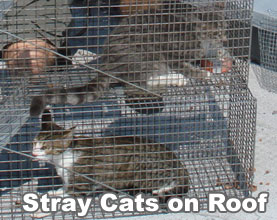 Stray Cat Info: Stray cats are defined as cats that are lost or have become separated
from a home or owner. When people refer to stray cats, they usually mean feral cats. Feral cats
are simply non-domesticated cats living in the wild. They were born in the wild, and have never had a
home. Their behavior is completely different from domesticated cats. They are truly wild animals! There are
60 million cats living in American households, and an estimated 100 million feral cats! Cats are very self-sufficient
(as most people are aware) and excellent hunters, and thus able to live in the wild just fine.
Sometimes I am called to trap them, when the free county service won't help.
Stray Cat Info: Stray cats are defined as cats that are lost or have become separated
from a home or owner. When people refer to stray cats, they usually mean feral cats. Feral cats
are simply non-domesticated cats living in the wild. They were born in the wild, and have never had a
home. Their behavior is completely different from domesticated cats. They are truly wild animals! There are
60 million cats living in American households, and an estimated 100 million feral cats! Cats are very self-sufficient
(as most people are aware) and excellent hunters, and thus able to live in the wild just fine.
Sometimes I am called to trap them, when the free county service won't help.
Of all of
the wild animals I have dealt with, trapped feral cats can be the most ferocious! They claw, bite, hiss, emit
a nasty musk scent, and do anything to escape. I've seen ferals scale a ten foot wall. They're not to be
trifled with. When I capture cats I bring them to the humane society in the county I catch them in. They
are available for adoption of course, but most are put down after a certain time period. Many people
consider this a sad situation, but it is the reality of this country's cat problem. Bob Barker is right:
"Have your pet spayed or neutered!" Trap-Neuter-Release (TNR) programs are a great way to help control
the feral cat population without killing them.
Nuisance concerns: Most people who call about feral cats complain that the cats are living under
a deck or porch, making noise, fighting, or stealing pet food left outside. Many of these people have
a genuine concern and care for these animals, and don't like seeing the population getting out of hand.
Some people even begin to feed feral cats, and soon find that they are swarmed by hungry felines looking
for a free handout. I've even removed feral cats that have gotten inside the home and a few times have
removed cats in the attic.
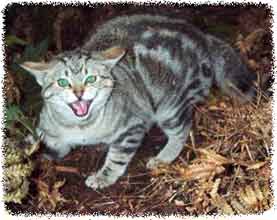 Stray cats are not vicious, nor are they normally aggressive to people (with one exception at a hotel I was hired to work at). Because the
people at the hotel were feeding the cats. Never feed stray cats - it
causes several problems.
Stray cats are not vicious, nor are they normally aggressive to people (with one exception at a hotel I was hired to work at). Because the
people at the hotel were feeding the cats. Never feed stray cats - it
causes several problems.
Stray cats will leaving droppings and urine in the areas they live, and will of course scratch and dig.
Stray cats are a source of fatal and non-fatal diseases transmittable to humans and domestic cats, including
rabies, ringworm, toxoplasmosis, cat scratch fever, allergies, feline leukemia,
feline distemper and secondary bacterial infections.
I actually deal with feral cats very rarely. In fact, I haven't bothered with one in many years. However, there have
been certain circumstances that have called for feral cat removal - such as a hotel where two patrons were scratched
by a very aggressive stray cat and had to seek rabies treatment. Here is my page about stray cat trapping.
Every now and then I get an angry email from a cat lover for advocating the trapping and removal (and possible future
euthanasia at the animal shelter) of stray cats. Some people advocate spay-neuter-release plans. I've heard mixed
arguments regarding this method. Here is one of the angry letters that I've received:
I was extremely disappointed when I read what you wrote about feral cats on your website. You are giving people inaccurate information about how to properly control their population. The WORST thing you can do is trap and remove them. All that does is remove their scent and allow new cats to come into the territory. The BEST thing you can do is get them fixed and release them back where they were found.
If you need accurate information to put on your site that will actually educate people properly, I will be glad to give it to you.
If you don't, but would like to educate yourself, please go to this site:
www.alleycat.org
Also, I sincerely doubt you bring these trapped feral cats to any Humane Society. You bring them to Animal Control (kill shelters).
You can read another email and advice about trap, neuter, release here.
 Nothing in my industry of nuisance wildlife control incites more controversy than stray cat control. The problem is that cats, (Felis catus) exist in basically two forms. There's the domesticated housecat and beloved pet, and then there's
the stray, or feral, cat which is often, for all intents and purposes, a nuisance wildlife species. I've observed many feral cats, living under dumpsters, in the woods, junkyards, and other
unsavory environs and their behavior is no different than that of raccoons, opossums, or rats. In fact, the cats...click for more
Nothing in my industry of nuisance wildlife control incites more controversy than stray cat control. The problem is that cats, (Felis catus) exist in basically two forms. There's the domesticated housecat and beloved pet, and then there's
the stray, or feral, cat which is often, for all intents and purposes, a nuisance wildlife species. I've observed many feral cats, living under dumpsters, in the woods, junkyards, and other
unsavory environs and their behavior is no different than that of raccoons, opossums, or rats. In fact, the cats...click for more
 Cats in the attic! Cats in the attic! All I keep hearing about is cats in the attic. Meowing and scratching! Prowling and mouse catching! Howling and rat snatching! Well, not howling so much. But yeah, cats in the attic. I remove
all kinds of wild animals from attics: raccoons, squirrels, opossums, rats, bats, and even cats. Most of the time, the customer hears scratching and scampering and clawing in the attic. But sometimes ...click for more
Cats in the attic! Cats in the attic! All I keep hearing about is cats in the attic. Meowing and scratching! Prowling and mouse catching! Howling and rat snatching! Well, not howling so much. But yeah, cats in the attic. I remove
all kinds of wild animals from attics: raccoons, squirrels, opossums, rats, bats, and even cats. Most of the time, the customer hears scratching and scampering and clawing in the attic. But sometimes ...click for more
And here's some other types of email regarding stray cats:
Hello
I live in Douglassville PA and was bitten by a stray cut very badly on 5/24/2018. I am finishing up on my last rabies shot on the 21st of this month. My neighbor across the street believes they just saw the cat that bit me in his
back yard as well as hiding under his deck. (not sure if it's there currently) When I was in Pottstown medical ER the 1st night they had me fill out forms so I am sure the bite is registered. I know it was because the following
day I was contacted by the PA health department. I was curious as to any alternatives you could provide to try and catch this feral cat as well as getting information from the state?
dear sirs: I am disabled, in a power chair, and I have marauding feral cats come over on my property, which I cannot get to; and they kill and eat the birds, and squirrels, right in front of me. If something is not done about this, I'll have to find someone to catch them, or get rid of them, I do not have the money for that, I am on disability, in a wheelchair. I'm sick of this, and don't tell me, this is not a wild animal that is not a nuisance. Please get ahold
of me.
Wondering how to get rid of feral cats? There is no magic spray or device that you can use to make them go away. Some people
try to sell predator urine, such as coyote or fox urine to get rid of feral cats, but that doesn't work. They also try to sell
ultrasonic sound emitters. These devices are worthless at eliminating feral cats. Some old wives' tales recommend the use of
mothballs or ammonia-soaked rags to make them leave, but I've been to countless homes where these techniques failed - biologists
know that these attempts won't work. The ONE AND ONLY WAY to take care of your stray cat problem is with trapping and removal of the animals such as provided by
my friend Patrick at his Boca Raton Fort Lauderdale Cat Control business or other local services in your area,
or perhaps you will find that trapping-spay-neuter-release programs are the best bet for feral cat control. And for goodness' sake, don't feed stray cats!
It always causes problems, including the spread of diseases and an increase in the stray cat population, and then starving and suffering when the feeding stops.
If you need to find a professional trapper in your hometown to safely trap and transport feral cats, just click our comprehensive list
of hundreds of animal removal professionals, and you can have your problem taken care of, for a fee. You can also call
your local animal services when it comes to feral cats, and they may assist for free.
Here are some of my stray cat educational articles:
Trap Neuter Release Programs for Stray Cats
Stray Cat Trapping Techniques
Stray Cats in the Attic
Should You Feed Stray Cats?
Common problems caused by stray cats
How to catch a stray cat to bring it to the shelter
How many stray cats are in the United States?
What should you do if you find a litter of stray kittens?
How to Adopt a Stray Cat
What to do About Stray Cat Fighting and Spraying
More Information on How to Get Rid of Feral Cats
A feral cat is a cat that was once domesticated but has for one reason or another returned to the wild. Although people refer to them as stray cats, there is a difference. These cats are actually given birth to in the wild. However, if a stray cat gives birth to their kittens in the wild, they are referred to as feral cat. There are at least 1-2 thousand colonies of over 260,000 feral cats in the wild today. This could be because they existed even before the settlements of the Europeans. Feral cats often increase dramatically in numbers every year due to the fact that one female feral cat within five years can produce about 400,000 kittens or more. However, their life expectancy in the wild is only between two to eight years.
Centuries ago, feral cats were introduced to different islands when rabbits were release to give travelers a potential food source. Because the rabbit's numbers started to get out of control, feral cats were brought into the picture. However, feral cats had a hard time hunting rabbits so they begin to turn to more local species for food. As their numbers began to expand, they were considered a pest as well.
Where Do They Live?
Feral cats can live in the wild, alleys, condemned buildings, empty lots and even your backyard. They often stick in the areas that offer the most food source.
Feral Cat Nuisances
Feral cats have a dramatic effect on the ecosystem because they prey on other mammals, birds and other small animals, which is the main cause of extinction on some islands.
Diseases
Feral cats can carry a host of diseases as well as fleas, intestinal microorganisms, ear mites, ringworms and respiratory infections. Because of the diseases that these feral cats can incur while their immune systems are too weak to fight them off, many of the kittens that they give birth to don't survive. They can catch feline leukemia, become anemic and catch feline immunodeficiency, which comes from sexual activity and fighting.
How to Get Rid Of Them
Local authorities are encouraging people to use the TNR (trap, neuter, return) process when they come across a feral cat. You would basically trap the feral cat, take him/her to be neutered or spayed and then release the cat back into the wild. This eliminates more feral cats from being born. This also gives existing feral cats more food and shelter and they can live healthier lives in the wild.
Traps
Using a trap to catch a feral cat requires you to take extreme caution. You don't want to try and catch them yourself because they may scratch you and this can cause you to get an infection or disease. Once you've purchased your feral cat trap, place it wherever you have seen the feral cat the most. Try to put it in an area where the cat can feel safe until you return. Avoid putting it in open areas where others can have access to it. Take some newspaper and put it inside the bottom of the trap so that when the cat walks up to it, he won't see the wire. However, be careful not to position the paper in a way where the trip can be triggered. Now it's time to place the bait over the trip, at the rear of the trap and a little outside to lure the cat in easily.
The bait should be on the trip to a point where the cat will have to apply pressure in order to activate it. Camouflage the trap a bit with branches, leaves or twigs. Within time, the feral cat will show up again at the same spot and smell the food. When a feral cat enters the trap and eats the food, the trip will go off and the door will automatically close. These types of traps will in no way hurt the feral cat or any other animals. Once you realize that you have the feral cat trapped inside, you can then take it to be neutered and spayed.
When you do this, not only do you keep the cat from having more babies who will suffer the same fate, but you increase their lifespan and help them live healthier lives in the wild.
Select Your Animal

Raccoons Raccoon Removal Advice & Information

Squirrels Squirrel Removal Advice & Information

Opossum Opossum Removal Advice & Information

Skunks Skunk Removal Advice & Information

Rats Rat Removal Advice & Information

Mice Mouse Removal Advice & Information

Moles Mole Removal Advice & Information

Groundhog Groundhog Removal Advice & Information

Armadillos Armadillo Removal Advice & Information

Beaver Beaver Removal Advice & Information

Fox Fox Removal Advice & Information

Coyotes Coyote Removal Advice & Information

Birds Bird Removal Advice & Information

Bats Bat Removal Advice & Information

Snakes Snake Removal Advice & Information

Dead Dead Animal Removal Advice & Information

OthersOther Wildlife Species Advice & Information